Choosing commercial lighting in 2026 requires more than comparing wattage and prices. The right fixture must support safety, productivity, visual comfort, and long-term operating value. The International Energy Agency’s Energy Efficiency 2024 report identifies lighting efficiency as an important pathway for reducing electricity demand across buildings. Yet efficiency alone can mislead. A bright warehouse aisle, a retail display, and an office desk need different optical performance.
So, how to choose LED lights for commercial spaces? Start with measured lumens, efficacy, beam angle, color temperature, and color rendering index. The U.S. Department of Energy’s solid-state lighting research reports show continuing progress toward higher LED efficacy and better controllability. However, published laboratory figures may not match field conditions. Dust, ceiling height, surface reflectance, heat, and driver quality can reduce real performance. That gap deserves attention.
A practical specification should also review glare control, flicker performance, dimming compatibility, occupancy sensors, emergency requirements, and warranty terms. DLC and ENERGY STAR listings can support product verification, but certification does not replace a site assessment. For a 10-meter warehouse ceiling, narrow optics may create dark zones between racks. In a boutique, excessive brightness can flatten product colors and make customers uncomfortable. Small details matter.
Energy modeling should compare purchase cost, installation, maintenance, controls, and expected service life. The U.S. DOE and other energy agencies consistently emphasize lifecycle savings rather than simple fixture cost. Still, forecasts are not guarantees. A qualified lighting professional should verify lux levels after installation, review control settings, and document actual energy use. Better decisions come from evidence, not impressive packaging.
Understanding Commercial LED Light Types and Applications
2026 Best Commercial LED Lights: How to Choose?
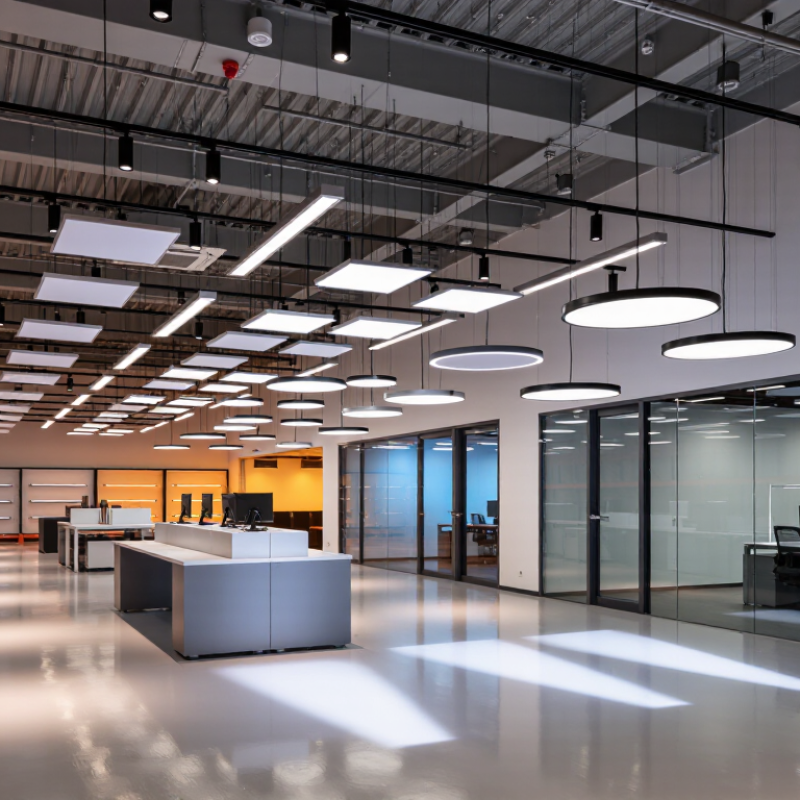
Understanding commercial LED light types starts with the space, not the fixture catalogue. Offices often use recessed troffers or slim panels for even, low-glare illumination. Warehouses need high-bay fixtures with focused optics and strong thermal management. Parking areas commonly require wall packs, canopy lights, or area fixtures. Damp locations may need sealed, vapor-tight housings. The application decides the light distribution, mounting method, color temperature, and protection rating.
Energy data supports careful conversion. The U.S. Energy Information Administration’s 2018 Commercial Buildings Energy Consumption Survey found lighting represented about 17% of commercial-building electricity use. The U.S. Department of Energy reports that LED lighting can use at least 75% less energy than incandescent lighting and last up to 25 times longer. These figures are useful, but they do not guarantee savings. Poor controls, excessive brightness, and unsuitable optics can weaken the result.
Look beyond wattage. Compare delivered lumens, efficacy, glare control, color rendering, dimming compatibility, and expected lifetime. A warehouse may need occupancy sensors and daylight harvesting. A retail space may require higher color rendering for accurate product appearance. I would not choose the highest lumen output automatically. Too much light can create glare and wasted energy. The DOE’s solid-state lighting research also highlights controls, quality, and reliability as important performance factors. Commissioning still gets overlooked. That is a mistake worth reconsidering.
Assessing Brightness, Color, and Energy Efficiency Requirements
2026 Best Commercial LED Lights: How to Choose?
Commercial LED lighting succeeds when brightness matches the task, not when a fixture produces the highest lumen number. In a warehouse, measure lux at floor level and along aisles. Compare readings near shelves, corners, and loading doors. A bright ceiling can still leave dark work surfaces. For offices, glare matters as much as output. Choose optics that spread light evenly, and review mounting height before deciding on wattage. My field assessments often find that a modestly brighter fixture performs better after repositioning.
Tips: Define the visual task first. Reading labels may require more usable light than storing cartons. Check color temperature, too. Neutral white light around 3500–4500K often supports clear commercial spaces, but warmer light may suit customer-facing areas. Color rendering also deserves attention. A high CRI can make products, food, and printed materials look more natural. Yet CRI alone is not a complete quality test; inspect samples under the actual lighting.
Energy efficiency means more than watts saved. Compare delivered lumens per watt, expected operating hours, dimming compatibility, and maintenance access. Occupancy sensors and daylight controls can reduce waste when correctly commissioned. Do not trust a datasheet blindly. Field conditions, dust, voltage, and control settings can change results. Record baseline energy use, test a small area, and allow room for revision. The first choice may be wrong.
2026 Best Commercial LED Lights: How to Choose?
Compare representative commercial lighting targets for brightness and energy efficiency, then select color temperature and color quality according to the application.
Brightness
Use maintained illuminance in lux as the design target. Offices and retail areas commonly require more light than warehouses and parking areas.
Color
A 3500–4000 K CCT is suitable for many offices, 3000–3500 K can support a welcoming retail environment, and 4000–5000 K is common for warehouses and parking areas. Choose CRI 80+ for general areas and CRI 90+ where color accuracy matters.
Energy Efficiency
Higher luminaire efficacy, measured in lumens per watt, can reduce installed wattage while maintaining the required light level. Controls such as occupancy and daylight sensors can further reduce operating energy.
Representative design values for comparison: illuminance targets are typical planning levels for commercial spaces, while efficacy values reflect practical ranges for modern commercial LED luminaires. Final selection should follow local codes, room geometry, maintenance factors, and a photometric layout.
Comparing Lifespan, Durability, and Environmental Performance
Choosing commercial LED lights in 2026 requires more than comparing wattage. A fixture above a loading dock faces dust, vibration, heat, and repeated switching. The U.S. Department of Energy reports that quality LED products commonly provide 25,000 to 50,000 hours of service. Some designs claim longer lives. Treat those figures carefully. They usually describe lumen maintenance, not failure-free operation. A reliable specification should state L70, testing conditions, driver life, and warranty coverage.
Durability depends on the installation environment. For dusty or wet areas, an IP65 enclosure offers stronger protection than an indoor-rated housing. In sports facilities or warehouses, impact ratings and thermal management also matter. IES LM-80 testing and TM-21 projections help evaluate LED package performance. However, projections are not promises. The weakest component may still be the driver, seal, or connector. No fixture is immortal.
Environmental performance includes electricity use, replacement frequency, controls, and disposal. The International Energy Agency estimates that lighting represents roughly 15% of global electricity consumption and about 5% of greenhouse gas emissions. The U.S. EPA states that LED products use at least 75% less energy and can last up to 25 times longer than incandescent lamps. Commercial buyers should also check dimming compatibility, occupancy sensors, recyclable housing materials, and hazardous-substance declarations. Energy savings can disappoint when controls are poorly commissioned. That part is often overlooked. A lifecycle comparison should include manufacturing, maintenance visits, replacement parts, and end-of-life handling, not only the first-year electricity bill.
2026 Best Commercial LED Lights How to Choose? - Comparing Lifespan, Durability, and Environmental Performance
| Commercial LED Light Type |
Typical Rated Life
(hours) |
Typical Lumen Maintenance |
Typical Efficacy
(lm/W) |
Durability Indicators |
Environmental Performance |
Best-Fit Applications |
| LED High-Bay |
50,000–100,000 |
≥70%–90% at rated life |
130–190 |
Aluminum heat sink; IP65–IP66; impact ratings commonly IK08–IK10 |
Low energy use; long replacement intervals; recyclable aluminum housing |
Warehouses, factories, distribution centers, sports facilities |
| LED Linear High-Bay |
50,000–100,000 |
≥80%–90% at rated life |
120–180 |
Extruded aluminum body; IP20–IP54 indoors; modular drivers available |
Efficient aisle illumination can reduce over-lighting and material use |
Retail warehouses, workshops, manufacturing aisles |
| LED Troffer or Panel |
50,000–100,000 |
≥80%–90% at rated life |
100–160 |
Steel or aluminum frame; indoor-rated; diffuser quality affects impact resistance |
Suitable for daylight and occupancy controls; contains no mercury in the LED source |
Offices, schools, hospitals, commercial interiors |
| LED Street and Area Light |
75,000–100,000 |
≥80%–90% at rated life |
110–170 |
IP66 or higher; corrosion-resistant housing; surge protection is important |
Lower power demand; optical control can reduce uplight and light trespass |
Roads, parking lots, campuses, loading yards |
| LED Floodlight |
50,000–100,000 |
≥70%–90% at rated life |
120–180 |
IP65–IP66; tempered glass or polycarbonate lens; surge protection recommended |
Directional optics can reduce wasted illumination and operating energy |
Security lighting, façades, sports areas, construction sites |
| LED Vapor-Tight Fixture |
50,000–100,000 |
≥80%–90% at rated life |
110–160 |
IP65–IP67; sealed housing; resistant to dust, moisture, and washdown conditions |
Long service life reduces maintenance trips and replacement waste |
Food-processing areas, parking garages, tunnels, utility spaces |
| LED Retrofit Tube |
30,000–60,000 |
≥70%–85% at rated life |
100–160 |
Performance depends on tube construction, ballast compatibility, and socket condition |
Can reduce retrofit waste, but compatibility and end-of-life recycling must be checked |
Existing fluorescent fixtures in offices, stores, and service areas |
Selection Checklist:
Compare rated life using the same test basis, preferably an LM-80/TM-21-supported L70 value. Verify operating temperature, ingress protection, impact resistance, surge protection, driver replaceability, power factor, flicker performance, controls compatibility, and photometric test data before purchase.
Notes: Values shown are typical industry ranges for commercial LED products and vary by design, operating temperature, drive current, installation conditions, and testing method. Rated life generally describes expected lumen maintenance rather than complete failure. LED products normally contain no mercury in the light-emitting source, but electronic components and metals should still be handled through appropriate electrical-waste recycling channels.
Conclusion
Choosing the right commercial LED lighting solution starts with understanding the different fixture types and their applications, from high-bay lights for warehouses to panel, tube, track, and outdoor fixtures. How to choose LED lights for commercial spaces depends on matching brightness, beam angle, color temperature, color rendering, and energy efficiency with the needs of each area. A well-planned system should provide comfortable, consistent illumination while minimizing electricity use and maintenance demands.
It is also important to compare lifespan, durability, heat management, and performance in challenging environments. Before making a decision, review installation methods, dimming or sensor controls, emergency functions, and applicable safety standards. Finally, calculate total cost by considering purchase price, installation, energy consumption, maintenance, and replacement frequency. The best choice is not always the cheapest fixture, but the solution that delivers reliable performance, flexible control, efficient operation, and strong long-term value for the facility.

 Guangyao Lighting